
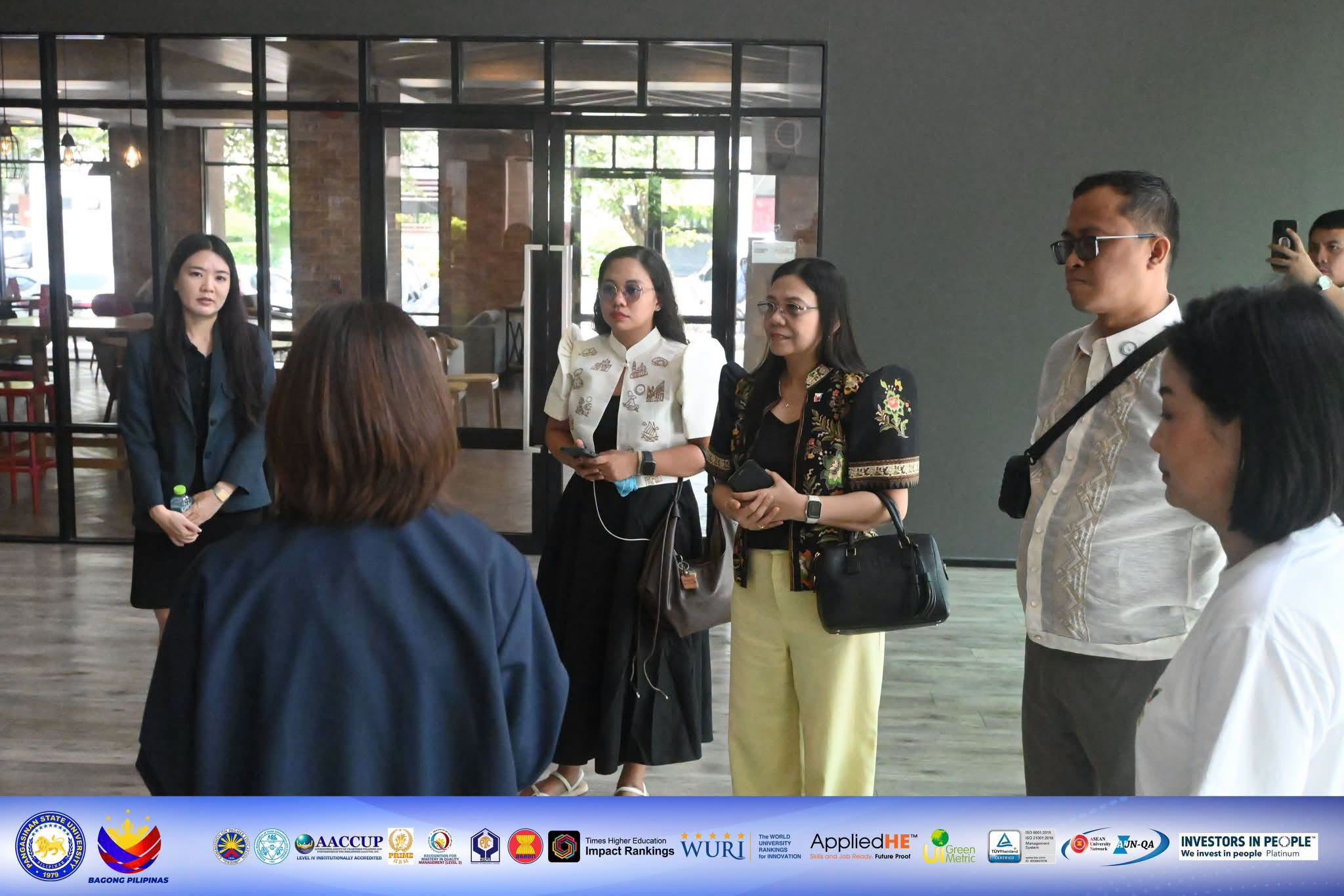
On the third day of the international benchmarking activity in Thailand, the Pangasinan State University Aligwas Technology Business Incubator delegation explored advanced startup ecosystems and innovation pathways during an official visit to Kasetsart University (KU). This activity was made possible through the initiative and assistance of Philippine Council for Industry, Energy, and Emerging Technology Research and Development (PCIEERD) of the Department of Science and Technology (DOST).
Kasetsart University is one of Thailand’s leading research universities recognized for its strong innovation ecosystem, startup development programs, and technology commercialization initiatives.
With the vision and support of the University President Dr. Elbert M. Galas, this activity took the dedicated team – Vice President for Research, Extension, and Innovation Dr. Razeale G. Resultay, Faculty Regent Mr. Ace John Mark P. Liwanag, PSU Aligwas TBI Project Leader Dr. Roseanne Agustin-Cera, TBI Core Member Engr. Roy Flores, and Vice President for Local and International Affairs Dr. Renato E. Salcedo – to examine world-class frameworks in agricultural innovation, technology commercialization, and business incubation.
Representing the Kasetsart University team was headed by Mr. Kittipong “Nat” Rattanaporn, Program Manager of the KU Technology Acceleration Center (KU-TAC), together with Coordinator Ms. Thanida Tungchaisin and Assistant Dean for Corporate Communications Ms. Busarin Chongcharoentanon.
During the immersive sessions, the delegation closely examined Kasetsart University’s signature Explore–Build–Launch–Scale framework. The Explore stage highlights how the university fosters an early entrepreneurial mindset through foundational courses, innovation camps, and advanced labs like the True Lab and the FI@KU Food Innovation Laboratory.
For the Build stage, the visit provided deep insights into the work of the Kasetsart University Business Incubator Center (KUBIC). KUBIC heavily supports student entrepreneurs by providing structured programs such as KU Startup 101 and startup bootcamps, followed by dedicated mentors and business coaches who guide teams through idea validation, customer discovery, and business planning. Simultaneously, faculty researchers utilize the Sprout KURDI program for a smooth commercialization pipeline spanning invention disclosures, intellectual property validation, and business model development.
Moving forward to the Launch and Scale stages, the delegation explored the vital role of the KU Technology Acceleration Center (KU-TAC). KU-TAC acts as the core acceleration platform bridging incubation and commercialization by preparing startups for investment readiness, mentoring networks, peer networking, and Demo Days. Furthermore, KU-TAC connects mature startups to major international scaling partners such as SPACE-F, Leave a Nest, InnoSpace Thailand, and the Digital Economy Promotion Agency (depa).
The insights gained from Kasetsart University serve as an exceptional model for enhancing our local entrepreneurship programs, commercialization pipelines, and acceleration services. Furthermore, this benchmarking milestone establishes a strong foundation for future cooperative initiatives between both institutions, aligning our efforts to foster world-class, innovation-driven enterprises.